Farro: Italy's Beloved Ancient Wheat — Nutrition, Cooking, and Uses
The complete guide to farro — the chewy, nutty Italian grain that comes in three types. Learn about nutrition, cooking methods, and why chefs love it.
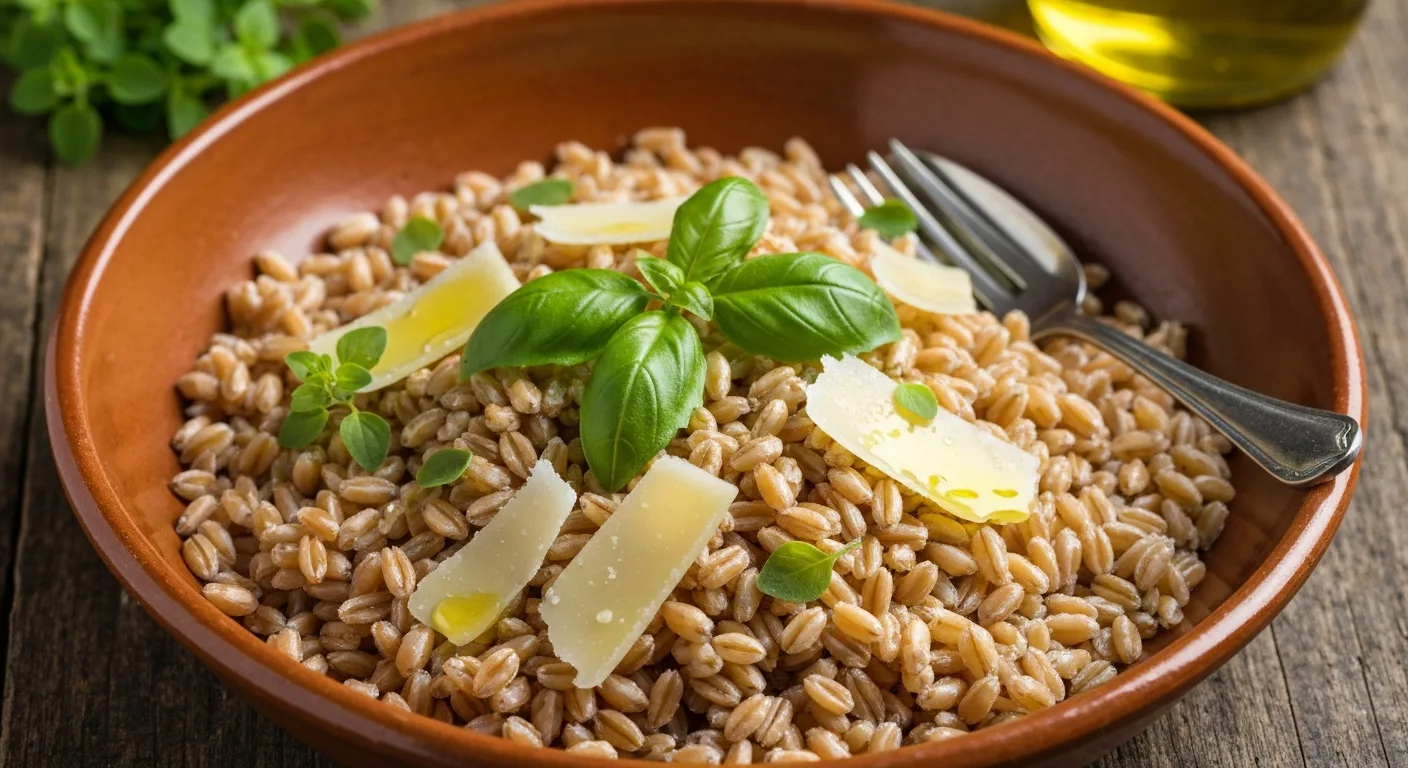
Walk into any serious Italian kitchen and you will likely find farro. This ancient wheat has anchored Italian cuisine for thousands of years, long before pasta dominated the peninsula, and its nutty, chewy character has made it a favorite of chefs and home cooks around the world. But the term “farro” hides surprising complexity, and understanding what you are actually buying makes all the difference in the kitchen.
What Is Farro?
Farro is the Italian culinary term for certain ancient hulled wheat species. In common usage, especially outside Italy, farro almost always refers to emmer wheat (Triticum dicoccum), a tetraploid wheat with 28 chromosomes that was one of the first crops domesticated by humans in the Fertile Crescent roughly 10,000 years ago.
However, in Italy, the word farro technically encompasses three distinct wheat species:
- Farro piccolo (small farro) — einkorn (Triticum monococcum), the oldest domesticated wheat
- Farro medio (medium farro) — emmer (Triticum dicoccum), the most common type sold as “farro”
- Farro grande (large farro) — spelt (Triticum spelta)
When you purchase a package labeled “farro” in the United States, Canada, or the UK, it is almost certainly emmer. Italian products may specify the type, and in Tuscany and Umbria — the heartland of Italian farro production — farro medio (emmer) is the default and the most prized. For a broader look at how ancient wheats compare to modern varieties, see our guide on ancient grains vs. modern wheat.
A Grain That Built Empires
Emmer wheat was among the eight “founder crops” of the Neolithic agricultural revolution. Archaeological evidence shows it was cultivated in the Fertile Crescent by 7500 BCE, and it spread rapidly across the Mediterranean, reaching Italy well before the Roman Republic.
The Romans relied heavily on farro, and the word farina (flour in Italian, and the root of the English word “farine”) derives directly from farro. Roman legionnaires received daily rations of emmer wheat, ground into porridge called puls, a dish that remained a Roman dietary staple long after bread-making techniques became widespread. The Latin word far referred to emmer specifically, and the Roman marriage ceremony included a rite called confarreatio, literally “sharing of farro,” in which the bride and groom ate a small cake made from farro flour.
As higher-yielding common wheat varieties (Triticum aestivum) became dominant in the medieval period, farro retreated to the mountainous regions of central Italy (particularly Tuscany, Umbria, Lazio, and the Marche) where hilly terrain and traditional farming practices preserved its cultivation. Today, Garfagnana farro from Tuscany holds IGP (Indicazione Geografica Protetta) status, a European designation protecting its regional identity and quality standards.
Understanding the Three Types of Farro (Processing Levels)
Beyond species, farro is sold in three processing levels, and this distinction has a dramatic effect on cooking time, nutrition, and texture. This is the most practically important thing to understand when buying farro.
Whole Farro (Farro Integrale)
This is the complete grain with the bran and germ intact. It is the most nutritious form, retaining all of the fiber, B vitamins, iron, and phytonutrients in the outer layers. Whole farro takes the longest to cook — typically 35 to 50 minutes — and benefits significantly from an overnight soak, which can reduce cooking time to 20-25 minutes. The texture is deeply chewy and robust.
Semi-Pearled Farro (Farro Semi-Perlato)
Part of the bran has been removed through light milling, but the germ remains. This is the best compromise: it cooks in 20-30 minutes without soaking, retains most of its nutritional value, and has a slightly more tender texture than whole farro. Semi-pearled farro is the most commonly sold type in specialty stores and is preferred by many Italian cooks.
Pearled Farro (Farro Perlato)
All of the bran and germ have been removed, leaving only the starchy endosperm. Pearled farro cooks quickly — 15 to 20 minutes — and has the softest texture. However, it has lost a significant portion of its fiber, B vitamins, and minerals. Pearled farro is functionally similar to white rice in terms of processing level, and while it is convenient, it sacrifices much of what makes farro nutritionally interesting.
How to tell them apart: Unfortunately, many packages simply say “farro” without specifying the processing level. Look at the grain itself: whole farro appears darker with visible bran layers; pearled farro is smooth, pale, and uniform. Cooking time listed on the package is also a clue: under 20 minutes almost certainly means pearled.
Farro Nutrition
Farro’s nutritional profile is strong, particularly in its whole or semi-pearled forms. Here is what a one-cup serving (about 170 grams) of cooked whole farro provides:
- Calories: 220
- Protein: 8 grams
- Fat: 1.5 grams
- Carbohydrates: 44 grams
- Fiber: 7 grams
- Iron: 2.5 mg (14% DV)
- Magnesium: 60 mg (14% DV)
- Zinc: 2.0 mg (13% DV)
- Niacin (B3): 3.5 mg (22% DV)
Protein Content
Farro contains approximately 7-8 grams of protein per cooked cup, slightly higher than brown rice and comparable to quinoa. Unlike quinoa and amaranth, farro is not a complete protein - it is limited in lysine, as are all true wheat species. However, combining farro with legumes (a classic Italian pairing, as in zuppa di farro e fagioli) provides complete amino acid coverage. For a comprehensive comparison of protein in heritage grains, visit our ancient grains nutrition guide.
Fiber
Whole farro is an outstanding fiber source, providing about 7 grams per cooked cup. This includes both soluble and insoluble fiber, supporting digestive health, cholesterol management, and blood sugar stability.
Micronutrients
Farro is particularly rich in B vitamins (especially niacin and thiamine), iron, magnesium, and zinc. As a whole grain, it provides a complex matrix of nutrients that work synergistically — a benefit that is diminished in pearled versions.
Farro Contains Gluten
This needs to be clear: farro is a wheat and it contains gluten. It is not safe for people with celiac disease or wheat allergy. This is a common source of confusion, partly because some older marketing materials mistakenly suggested that ancient wheats were gluten-free or lower in gluten than modern wheat.
Farro does contain a somewhat different gluten structure than modern bread wheat. Some individuals with non-celiac gluten sensitivity (a condition distinct from celiac disease) report tolerating farro and other ancient wheats better than modern wheat. However, this is anecdotal and inconsistent, and no one with a diagnosed gluten-related disorder should consume farro without medical guidance. For more on this topic, see our article on ancient grains and celiac disease.
How to Cook Farro
Farro is one of the most forgiving grains to cook. It is difficult to overcook into mush (unlike rice or quinoa), and it maintains its pleasant chewiness across a range of cooking times. For detailed instructions and variations, see our dedicated how to cook farro guide.
Absorption Method
- Rinse 1 cup of farro under cold water.
- If using whole farro, soak overnight in water and drain. Semi-pearled and pearled can be cooked without soaking.
- Combine farro with 2.5 cups of water or broth in a saucepan.
- Bring to a boil, reduce heat to medium-low, and simmer partially covered.
- Cook until tender but still chewy: 15-20 minutes for pearled, 20-30 for semi-pearled, 35-50 for whole.
- Drain any excess liquid and fluff.
Pasta Method (Easiest)
Many Italian cooks treat farro like pasta: boil it in a large pot of generously salted water, then drain when it reaches the desired tenderness. This method is foolproof and works for all three processing types. Simply taste the farro periodically and drain when it is pleasantly chewy with no hard center.
Pressure Cooker
A pressure cooker reduces whole farro cooking time to about 10-12 minutes at high pressure, with a natural release. This is an excellent option for meal prep.
Classic Farro Dishes
Farrotto
Italy’s answer to risotto, made with farro instead of arborio rice. The technique is similar: toast the farro in olive oil with aromatics, then add warm broth gradually, stirring frequently. Farro does not release starch as readily as risotto rice, so the result is less creamy but more texturally interesting. Finish with Parmigiano-Reggiano, a knob of butter, and seasonal vegetables. Mushroom farrotto and butternut squash farrotto are particularly popular.
Farro Salad
Cooked and cooled farro is a superb salad base. Its chewy texture holds up to robust dressings and does not become soggy when dressed in advance, making it ideal for meal prep and potlucks. A classic combination: farro, cherry tomatoes, cucumber, red onion, fresh herbs (basil, mint, parsley), feta cheese, and a lemon-olive oil vinaigrette.
Zuppa di Farro
A hearty Tuscan soup combining farro with white beans, tomatoes, dark leafy greens (kale or cavolo nero), olive oil, and Parmesan rind. This is peasant food at its best: nourishing, inexpensive, and satisfying.
Farro with Roasted Vegetables
Perhaps the simplest weeknight preparation: toss cooked farro with whatever roasted vegetables you have — sweet potatoes, Brussels sprouts, beets, cauliflower — add a drizzle of good olive oil or tahini dressing, and serve warm or at room temperature.
Flavor Profile
Farro’s flavor is a major selling point. The cooked grain has a pronounced nutty, slightly sweet taste with faint undertones of cinnamon and oat. The texture is chewy and substantial, with a pleasant bite that persists even when well-cooked. This “al dente” quality is one reason chefs gravitate toward farro; it adds textural contrast to dishes in a way that softer grains like rice cannot.
The flavor deepens when farro is toasted in a dry pan or in oil before adding liquid, a step worth incorporating into your cooking routine.
Storage
Dry farro stores exceptionally well. Kept in an airtight container in a cool, dark pantry, whole and semi-pearled farro remain viable for a year or more. Pearled farro, with its exposed starchy interior, has a slightly shorter shelf life but still keeps well for many months.
Cooked farro refrigerates well for up to five days. It actually improves in flavor after a day in the refrigerator as the grains firm up slightly. This makes it one of the best grains for weekend meal prep. Cooked farro also freezes well for two to three months.
Farro Among the Ancient Grains
On the ancient grains list, farro occupies a sweet spot between the nutritional powerhouses like quinoa and amaranth and the familiar comfort of wheat. It cannot match the pseudocereals for protein quality or gluten-free status, but it outperforms them in culinary versatility and sheer eating pleasure for many people. Its chewy texture, nutty flavor, and forgiving cooking behavior make it one of the most accessible ancient grains for people accustomed to modern wheat-based diets.
Farro also serves as a bridge between ancient and modern wheat. It shares enough genetic heritage with bread wheat to feel familiar, while retaining the flavor complexity, nutritional density, and agricultural hardiness that modern wheat varieties have sacrificed in pursuit of yield. For those who can eat gluten, farro may be the single best ancient grain to start with.
Last updated March 12, 2026