Ancient Grains and the Civilizations They Built
How ancient grains fueled the rise of great civilizations — from Mesopotamian barley to Aztec amaranth to Ethiopian teff.
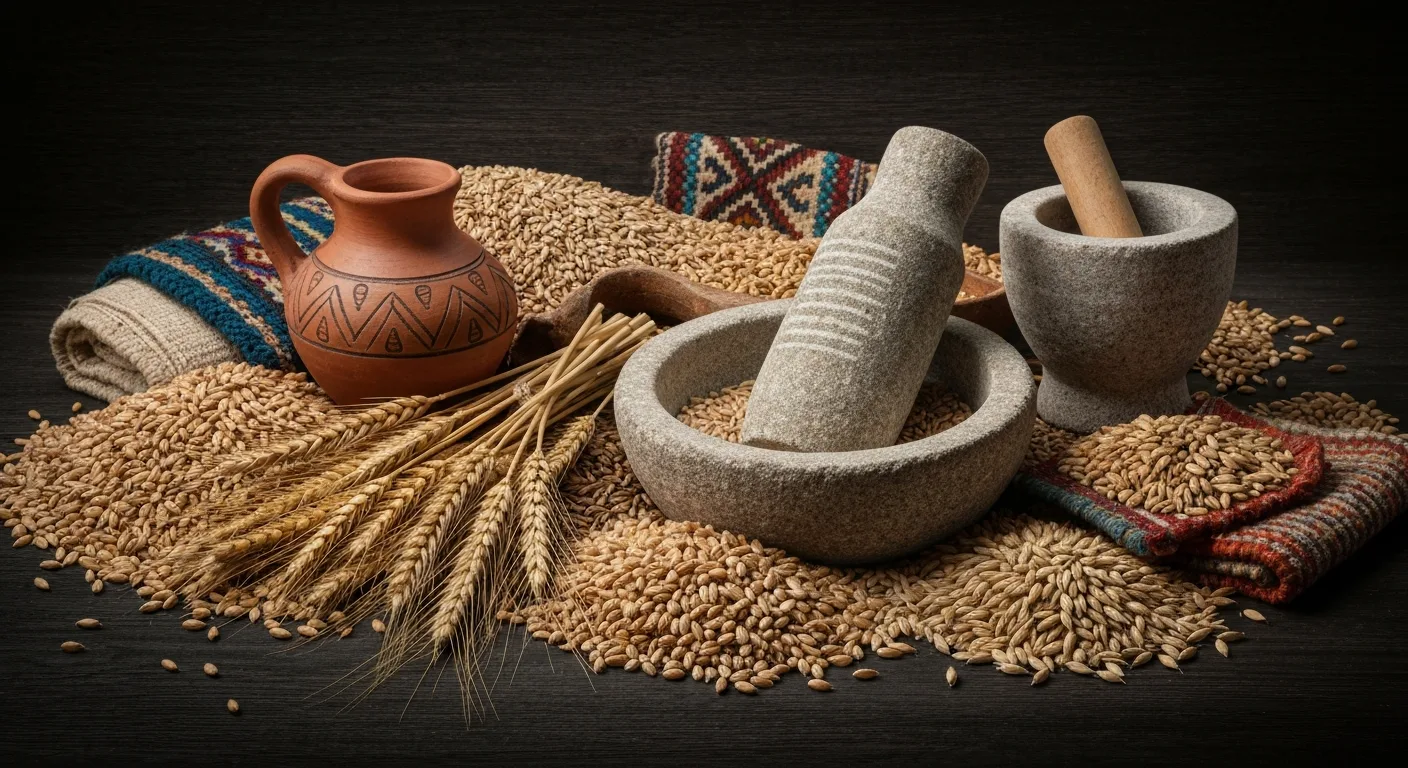
Every great civilization in human history was built on a grain. This is not metaphor - it is agricultural and historical fact. Before a society could develop writing, construct monuments, organize armies, or pursue scientific inquiry, it needed a reliable, storable, calorie-dense food source that could be produced in surplus. In every case, that food source was a grain.
The relationship between grain and civilization is so consistent across cultures and continents that it constitutes one of the strongest patterns in human history. Different grains, different climates, different peoples - but the same fundamental dynamic: grain surplus enables population growth, specialization, urbanization, and the accumulation of knowledge that we call civilization.
This article traces seven grain-civilization pairings that shaped the ancient world. Each reveals not only what people ate but how that food shaped their economy, religion, military power, and cultural identity.
For the broader timeline of grain domestication and its global impact, see our history of ancient grains.
Mesopotamia and Barley: The First Civilization
The grain: Barley (Hordeum vulgare) The civilization: Sumer, Akkad, Babylon, Assyria (c. 4000–539 BCE) The region: Southern Iraq, between the Tigris and Euphrates rivers
The world’s first cities - Ur, Uruk, Eridu, Lagash - rose in the flat, sun-baked alluvial plain of southern Mesopotamia. And they rose on barley.
Wheat was grown in Mesopotamia too, but barley dominated for a pragmatic reason: salt. Thousands of years of irrigation in the arid climate caused salt to accumulate in the soil, a process called salinization. Barley tolerates salt far better than wheat. By 2000 BCE, Sumerian agricultural records show that barley constituted over 80 percent of grain production in southern Mesopotamia, up from about 50 percent a millennium earlier.
Barley’s role in Mesopotamian life went far beyond food:
Currency. Before coinage, barley was money. Workers were paid in barley rations. The Code of Hammurabi (c. 1754 BCE) specified prices, fines, and wages in barley measures. A laborer might earn 1 gur (approximately 300 liters) of barley per year.
Beer. The Sumerians were prolific brewers, and barley was their primary brewing grain. The “Hymn to Ninkasi” - a 3,800-year-old poem addressed to the Sumerian goddess of beer - is essentially a barley beer recipe encoded in verse. Beer was consumed daily by people of all social classes and was safer than untreated water from the rivers and canals.
Religion. Barley offerings were central to temple rituals. Temples were not merely places of worship - they were economic institutions that owned vast tracts of farmland, employed thousands of workers, and collected barley tithes. The administrative requirements of managing these temple estates likely drove the development of writing itself: the earliest Sumerian texts (c. 3200 BCE) are accounting records tracking barley transactions.
Bureaucracy. The need to measure, record, store, and distribute barley created the world’s first bureaucracies. Scribes used cuneiform script on clay tablets to record grain inventories, tax payments, and ration disbursements. Mathematics developed in part to calculate volumes of grain stored in cylindrical and rectangular granaries.
Barley did not merely feed Mesopotamian civilization. It provided the economic substrate on which civilization’s fundamental technologies - writing, mathematics, law, institutional religion - first emerged.
Egypt and Emmer: Bread and Pyramids
The grain: Emmer wheat (Triticum dicoccum) The civilization: Ancient Egypt (c. 3100–30 BCE) The region: Nile Valley and Delta
Ancient Egypt’s wealth was the Nile, and the Nile’s gift was the annual flood that deposited rich, dark silt across the floodplain each summer. In this fertile soil, Egyptian farmers grew emmer wheat on a scale that astonished the ancient world.
Emmer was the wheat of the pharaohs. It has a tough husk that protects the grain during storage (critical in Egypt’s hot climate) and a high protein content that produces dense, flavorful bread. Egyptian bakers developed remarkable skill with emmer, producing over 30 identified types of bread - round loaves, conical loaves, flat breads, sweetened breads with dates and honey.
Bread and beer - both made from emmer - were the twin pillars of the Egyptian diet, consumed by everyone from pharaohs to field laborers. Workers building the Great Pyramid of Giza received daily rations of bread and beer. Archaeological evidence at the Giza workers’ village suggests that each laborer received approximately 10 loaves of bread and 4 to 5 liters of beer per day. Multiply that by the estimated workforce of 20,000 to 30,000, and the agricultural operation required to feed pyramid construction becomes staggeringly impressive.
Emmer’s importance extended into Egyptian religion and the afterlife. Grain offerings were placed in tombs to sustain the deceased in the next world. The god Osiris - ruler of the underworld - was explicitly associated with grain and agricultural fertility. Paintings in royal tombs depict every stage of grain production: plowing, sowing, harvesting, threshing, winnowing, grinding, and baking.
The Egyptian tax system was based on grain. Tax assessors would survey fields annually to estimate the expected harvest, and farmers would pay a portion in grain to the state. These grain taxes funded the pharaoh’s government, the priesthood, the military, and monumental construction projects. The enormous state granaries discovered at sites across Egypt testify to the scale of this system.
Rome and Spelt: Feeding the Legions
The grain: Spelt (Triticum spelta), later emmer and bread wheat The civilization: Roman Republic and Empire (c. 509 BCE–476 CE) The region: Mediterranean basin, extending to Britain and the Middle East
Rome’s relationship with grain was so central to its politics and survival that the Latin word for “peace” (pax) is etymologically related to the word for “food” (pasco, to feed). When Romans had grain, there was peace. When grain supplies were threatened, there was unrest, and sometimes revolution.
Spelt was the earliest grain of the Roman heartland, grown in central Italy from at least the Bronze Age. The Romans called it “far” - from which we get the modern Italian word “farro.” Spelt porridge (puls) was the original Roman staple food, eaten daily by soldiers, farmers, and city dwellers alike. The Roman satirist Juvenal’s famous phrase “bread and circuses” (panem et circenses) reflected the reality that Roman political stability depended on keeping the urban population fed.
As Rome expanded from a small Italian city-state into a Mediterranean empire, its grain needs outstripped local production. Egypt, conquered by Rome in 30 BCE, became the empire’s breadbasket. Egyptian emmer and, increasingly, bread wheat were shipped to Rome in vast grain fleets. At its peak, Rome imported approximately 300,000 tons of grain per year from Egypt and North Africa.
The annona - Rome’s public grain distribution - was one of the ancient world’s most ambitious social programs. By the late Republic, the state was providing free or subsidized grain to hundreds of thousands of Roman citizens. Administering this system required sophisticated logistics: shipping, port facilities, warehousing, record-keeping, and distribution infrastructure.
For the Roman military, grain was a strategic asset. Each legionary consumed approximately 850 grams of grain per day, ground into flour and baked into flatbread or cooked as porridge. A single legion of 5,000 men required roughly 4.25 metric tons of grain daily. Securing grain supply lines was a primary concern of every Roman military campaign, and disrupting an enemy’s grain supply was a standard strategic objective.
The Inca Empire and Quinoa: The Mother Grain
The grain: Quinoa (Chenopodium quinoa) The civilization: Inca Empire (c. 1438–1533 CE) The region: Andean South America, from Colombia to Chile
The Inca Empire was unique among major civilizations in that it developed without writing, without the wheel, and without iron tools. What it did have was an extraordinarily sophisticated agricultural system built around complementary crops grown at different elevations - and at the highest altitudes, quinoa was king.
Quinoa’s complete protein profile - all nine essential amino acids - made it nutritionally irreplaceable in the high Andes, where meat was scarce and many other crops could not grow. The Inca recognized this, naming quinoa “chisaya mama” (mother grain) and treating it as sacred.
The Inca agricultural system used vertical ecological zones - growing different crops at different altitudes to create a nutritionally complete diet. Corn thrived in lower valleys (below 3,400 meters), potatoes grew at middle elevations, and quinoa dominated the highest farmland (up to 4,000 meters). This vertical integration was managed through a centralized state system that redistributed products between zones.
Quinoa sustained Inca military expansion in a literal sense. Soldiers carried quinoa-based rations (mixed with fat into compact “war balls”) that provided complete nutrition, stored indefinitely, and weighed little relative to their caloric value. This logistical advantage allowed Inca armies to campaign across vast distances in some of the most challenging terrain on earth.
The full story of quinoa’s role in Inca civilization, its suppression by Spanish colonizers, and its modern revival is told in our dedicated article on the history of quinoa.
The Aztec Empire and Amaranth: The Forbidden Grain
The grain: Amaranth (Amaranthus cruentus and A. hypochondriacus) The civilization: Aztec Empire (c. 1300–1521 CE) The region: Central Mexico
Amaranth’s story is perhaps the most dramatic of any ancient grain, involving religious ceremony, imperial power, and deliberate cultural destruction.
The Aztecs cultivated amaranth extensively, and it was one of their most important crops alongside corn, beans, and chia. Approximately 20,000 tons of amaranth were collected annually as tribute from conquered provinces - roughly the same amount as corn, indicating their equivalent agricultural importance.
Amaranth’s significance went far beyond nutrition. The Aztecs used amaranth in religious ceremonies that alarmed and offended Spanish conquistadors and missionaries. During the festival of Huitzilopochtli (the Aztec sun and war god), women would mix amaranth flour with honey and sometimes human blood sacrificed during the ceremony, forming the mixture into a figure of the god. This figure was then broken apart and consumed by worshippers - a practice that bore an unsettling resemblance to the Catholic Eucharist.
This resemblance was not lost on the Spanish. When Hernan Cortes conquered the Aztec capital of Tenochtitlan in 1521, the colonial authorities moved quickly to suppress amaranth cultivation. Growing amaranth was banned, and anyone caught with amaranth plants could face severe punishment. The ban was enforced with varying degrees of effectiveness across different regions, but its impact was devastating. Amaranth production plummeted, and the crop survived primarily in remote mountain communities.
Amaranth’s near-destruction is one of the clearest examples in history of a grain being targeted as a tool of cultural suppression. The Spanish understood - correctly - that controlling food systems was essential to controlling people. By eliminating a crop so deeply woven into Aztec religious and cultural life, they struck at the foundations of indigenous identity.
Amaranth has recovered somewhat in the modern era. It is now grown commercially in Mexico, India, China, and parts of Africa and is recognized as a nutritionally exceptional grain, particularly high in protein (including the amino acid lysine, which most grains lack), iron, and calcium.
Ethiopia and Teff: The Invisible Grain
The grain: Teff (Eragrostis tef) The civilization: Aksumite Empire and subsequent Ethiopian states (c. 100–present) The region: Ethiopian Highlands
Teff’s relationship with Ethiopian civilization is remarkable for its continuity. While other grain-civilization pairings were disrupted by conquest, trade, or technological change, teff has remained the foundational food of Ethiopian culture for at least three thousand years, possibly longer.
The Aksumite Empire (c. 100–940 CE) was one of the great powers of the ancient world, controlling trade routes between the Roman Mediterranean and the Indian Ocean. Aksum was the first sub-Saharan African state to mint its own coins, and it adopted Christianity in the 4th century - one of the earliest states to do so. Throughout all of this, teff was the staple grain.
Teff’s dominance in Ethiopia is partly explained by its agricultural advantages. It matures in as few as 60 days, tolerates waterlogging and drought, grows at altitudes from sea level to 2,800 meters, and is not susceptible to most grain pests (its seeds are too small for weevils to infest). For Ethiopian farmers working in a climate of uncertain rainfall and diverse terrain, teff’s reliability was unmatched.
But teff’s cultural significance transcends agronomics. Teff is injera, and injera is the foundation of Ethiopian communal eating. The large, spongy flatbread is placed on a shared platter, topped with various stews (wot), and torn off with the right hand to scoop up food. Eating from a shared injera is an act of community and intimacy - couples feed each other injera during the “gursha” ritual, and sharing injera with someone signifies trust and connection.
Teff injera also demonstrates sophisticated food science. The fermentation process (typically 2 to 3 days) produces lactic acid bacteria that partially break down teff’s phytic acid, improving mineral absorption. The fermentation also creates the bubbles that give injera its characteristic spongy texture and adds a pleasant sourness that complements the rich spices of Ethiopian cuisine.
Ethiopia’s government has historically restricted teff exports to protect domestic food security, recognizing the grain’s irreplaceable role in national diet and culture. This restriction has limited teff’s international availability but also preserved Ethiopia’s near-monopoly on teff production and the cultural knowledge associated with it.
China and Millet: The Yellow River Foundation
The grain: Foxtail millet (Setaria italica) and broomcorn millet (Panicum miliaceum) The civilization: Yangshao, Longshan, and early Chinese dynastic cultures (c. 6000 BCE onward) The region: Yellow River valley, northern China
Before rice became synonymous with Chinese cuisine, millet was the grain of China. Archaeological evidence places millet cultivation in the Yellow River region by at least 6,000 BCE, making it one of the earliest domesticated crops in East Asia and roughly contemporaneous with wheat and barley domestication in the Middle East.
The divide between millet-eating northern China and rice-eating southern China is one of the most fundamental cultural boundaries in Chinese history. It influenced cuisine, agriculture, settlement patterns, social organization, and even language. Northern Chinese civilizations - including the early dynasties that eventually unified China - were built on millet.
Millet’s importance to early Chinese culture is embedded in the language. The Chinese character for “grain” (gu) originally referred specifically to millet. The legendary ancestor-god of the Zhou dynasty was called Houji - “Lord Millet” - reflecting the quasi-divine status accorded to this crop.
Millet offered several advantages to early Yellow River farmers. It grows in semi-arid conditions with moderate rainfall - appropriate for northern China’s climate, which is drier than the rice-growing south. It matures in 60 to 90 days, allowing cultivation in regions with short growing seasons. It stores exceptionally well and can remain viable for years, providing food security against bad harvests.
The transition from millet to wheat and rice as China’s dominant grains occurred gradually over several thousand years, driven by the expansion of irrigation (enabling rice cultivation in previously dry regions), trade connections that introduced wheat from the west, and the higher caloric yield of rice paddies compared to millet fields. But millet never fully disappeared from Chinese agriculture and remains a significant crop in the northern provinces.
Patterns Across Civilizations
Looking across these seven grain-civilization pairings, several patterns emerge that illuminate the fundamental relationship between agriculture and complex society.
Each civilization’s grain was adapted to its specific environment. Barley tolerated Mesopotamian salt. Emmer thrived in Nile silt. Quinoa survived Andean altitude. Teff endured Ethiopian variability. Millet weathered northern China’s aridity. The grain did not merely feed the civilization - it determined where the civilization could exist.
Grain management drove institutional development. Writing, mathematics, law, and bureaucracy all developed at least partly in response to the needs of grain production, storage, taxation, and distribution. The administrative requirements of managing grain surplus created the institutional infrastructure of the state.
Grain carried spiritual and symbolic weight. In every civilization, the primary grain was associated with gods, ceremonies, and creation myths. This was not superstition - it was a rational response to absolute dependence. When your survival depends entirely on one crop, that crop acquires sacred status.
Control of grain was control of power. From Mesopotamian temple estates to Roman annona to Inca qollqa, the ability to collect, store, and distribute grain was the foundation of political authority. Governments that could not feed their populations did not survive.
Disrupting a civilization’s grain disrupted the civilization itself. The Spanish suppression of amaranth and quinoa was a deliberate attack on indigenous civilization conducted through the food system. It worked precisely because the relationship between grain and culture was so deep.
These patterns are not merely historical curiosities. They illuminate why food security remains a geopolitical priority, why agricultural policy is always political, and why the grains we eat are never just ingredients - they are, and always have been, the foundations of the world we live in.
For more on the full timeline of grain domestication and its global impact, return to our history of ancient grains. To learn about cooking with these historically significant grains, visit our complete cooking guide.
Last updated March 12, 2026