Ancient Grains Protein: Complete Guide to High-Protein Heritage Grains
Which ancient grains have the most protein? Compare protein content, amino acid profiles, and learn how to build complete proteins with grains.
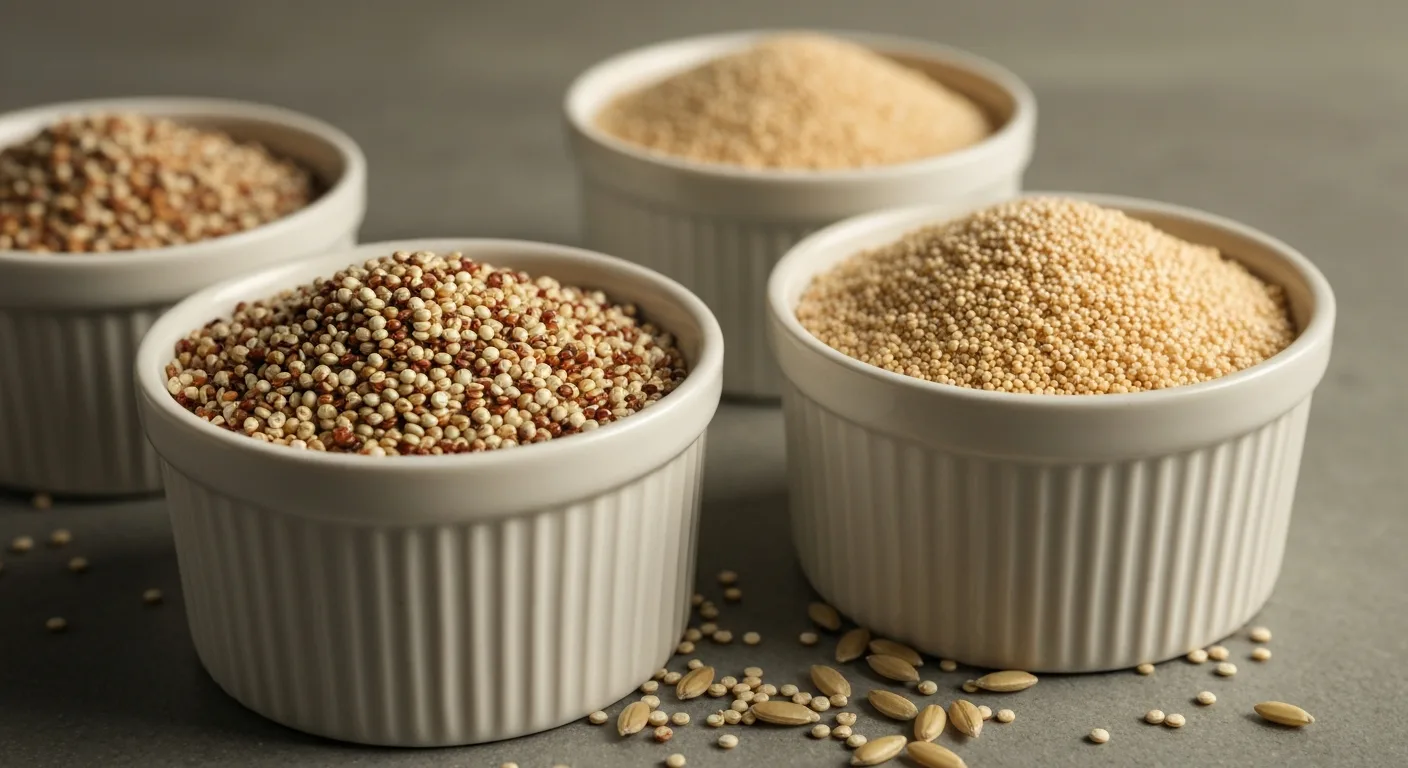
Protein is often the first nutrient people ask about when evaluating grains, especially those following plant-based diets or looking to reduce their reliance on animal products. The good news: ancient grains deliver significantly more protein than most people expect, and several of them - most notably quinoa and amaranth - provide complete protein with all essential amino acids.
This guide ranks ancient grains by protein content, breaks down their amino acid profiles, and provides practical strategies for meeting protein needs through grain-based diets. For the full nutritional picture including minerals, vitamins, and fiber, see our ancient grains nutrition guide.
Protein Content Rankings
The following table compares protein content across major ancient grains, presented both as dry weight (for purchasing and comparison purposes) and cooked weight (for practical meal planning). Modern whole wheat and white rice are included as reference points.
| Grain | Protein per 100g (dry) | Protein per 100g (cooked) | Protein per cooked cup (g) |
|---|---|---|---|
| Spelt | 14.6 | 5.5 | 10.7 |
| Kamut (Khorasan) | 14.5 | 5.3 | 9.8 |
| Freekeh | 14.4 | 5.3 | 9.7 |
| Einkorn | 14.3 | 5.2 | 9.6 |
| Quinoa | 14.1 | 4.4 | 8.1 |
| Farro (emmer) | 13.8 | 5.0 | 9.2 |
| Amaranth | 13.6 | 3.8 | 9.3 |
| Teff | 13.3 | 3.9 | 9.8 |
| Buckwheat groats | 13.3 | 3.4 | 5.7 |
| Sorghum | 11.3 | 3.6 | 8.4 |
| Millet | 11.0 | 3.5 | 6.1 |
| Barley (hulled) | 9.9 | 2.3 | 3.6 |
| Modern whole wheat | 13.2 | 3.9 | 7.5 |
| White rice | 6.6 | 2.7 | 4.4 |
Several takeaways from this data:
The ancient wheats dominate. Spelt, kamut, freekeh, einkorn, and farro consistently deliver 14+ grams of protein per 100 g dry weight, outperforming modern whole wheat. Spelt is the protein champion among cereal grains.
Quinoa and amaranth punch above their weight. While their per-100g cooked numbers are moderate (because they absorb substantial water), their protein per cup is competitive, and their protein quality (discussed below) sets them apart from all other grains.
Barley is the outlier. Despite many nutritional strengths - exceptional fiber, beta-glucan, and resistant starch - barley is the lowest-protein major grain. It shines in other areas but should not be relied upon as a primary protein source.
Amino Acid Profiles: Quality Matters as Much as Quantity
Protein quantity tells only part of the story. Protein quality - determined by the amino acid profile and digestibility - determines how effectively your body can use the protein you consume.
Essential Amino Acids
The human body requires nine essential amino acids that it cannot synthesize: histidine, isoleucine, leucine, lysine, methionine, phenylalanine, threonine, tryptophan, and valine. A protein source is considered “complete” when it provides all nine in adequate proportions relative to human requirements.
The Lysine Problem in Grains
Most cereal grains - wheat, rice, corn, barley, millet, sorghum - are limited in the amino acid lysine. This means that no matter how much wheat you eat, if it is your sole protein source, your body cannot fully utilize all the protein because lysine runs out first. The other amino acids that exceed the lysine-limited capacity are largely oxidized for energy rather than used for protein synthesis.
This is not a problem in practice for people eating varied diets, because legumes, nuts, dairy, eggs, and meat all provide abundant lysine. But for those relying heavily on grains, lysine limitation is the key nutritional challenge to address.
Complete Protein Grains
Three ancient grains stand out as complete protein sources:
Quinoa
Quinoa is the most well-known complete protein grain (technically a pseudocereal - the seed of a chenopod plant related to beets and spinach). Its amino acid profile meets or exceeds WHO/FAO requirements for all nine essential amino acids. Quinoa is particularly strong in lysine (5.1 g per 100 g protein), histidine, and isoleucine.
The protein digestibility-corrected amino acid score (PDCAAS) for quinoa ranges from 0.78 to 0.86 depending on the variety - higher than any cereal grain and comparable to casein (milk protein) for practical purposes. The newer Digestible Indispensable Amino Acid Score (DIAAS) for quinoa is similarly favorable.
Quinoa protein has also demonstrated good digestibility in vitro, with values typically ranging from 78-85%, compared to 85-95% for animal proteins. This is substantially better than the 60-75% digestibility typical of many legume proteins (which are reduced by trypsin inhibitors and other antinutritional factors).
Amaranth
Amaranth is the second pseudocereal with a complete amino acid profile. Its lysine content (5.2 g per 100 g protein) actually exceeds quinoa’s, making it the richest grain source of this often-limiting amino acid. Amaranth is also notably high in methionine and cysteine (the sulfur-containing amino acids), which are limiting in many legumes.
Amaranth’s protein digestibility is influenced by preparation method. Raw amaranth has relatively low digestibility due to antinutritional factors, but popping, boiling, or fermenting amaranth increases protein digestibility to 80-90%. Traditional Mesoamerican preparation methods - popping and mixing with honey (alegria) or fermenting - effectively optimize protein availability.
Buckwheat
Buckwheat, despite its name, is not related to wheat - it is the seed of a plant in the Polygonaceae family (related to rhubarb and sorrel). Its amino acid profile is nearly complete, with good levels of lysine (6.1 g per 100 g protein - the highest of any grain) and excellent levels of arginine and aspartic acid. Buckwheat’s PDCAAS is typically calculated at 0.61-0.71, somewhat lower than quinoa due to slightly limiting levels of leucine in some calculations, but functionally it provides a near-complete amino acid profile for most practical purposes.
Buckwheat protein also contains bioactive peptides with demonstrated ACE-inhibitory (blood pressure-lowering) and cholesterol-reducing properties, adding functional benefits beyond basic nutrition.
Incomplete Protein Grains: Amino Acid Limitations
For grains that are not complete proteins, here is where each one falls short and how to compensate:
| Grain | Limiting Amino Acid(s) | Best Complementary Foods |
|---|---|---|
| Spelt | Lysine | Lentils, chickpeas, beans |
| Kamut | Lysine | Legumes, dairy, eggs |
| Farro | Lysine | Beans, peas, lentils |
| Einkorn | Lysine | Legumes, soy products |
| Freekeh | Lysine | Chickpeas, lentils |
| Teff | Lysine (mild limitation) | Legumes, especially Ethiopian misir wot |
| Millet | Lysine, threonine | Beans, peanuts, dairy |
| Sorghum | Lysine, threonine | Cowpeas, lentils, groundnuts |
| Barley | Lysine | Beans, lentils, fish |
Teff deserves special mention. While technically lysine-limited like other cereals, its lysine content is higher than most grains - roughly 3.7 g per 100 g protein versus 2.6 g in modern wheat. This means teff comes closer to meeting essential amino acid requirements on its own than most cereals, though it still falls short of the complete protein threshold.
Protein Complementation: Building Complete Proteins
The concept of protein complementation - combining foods whose amino acid profiles offset each other’s limitations - has been practiced intuitively by cultures worldwide for millennia.
Classic Grain-Legume Combinations
Every major grain-based food culture independently developed grain-legume pairings:
- Ethiopia: Teff injera with misir wot (red lentil stew)
- India: Millet roti with dal (lentil curry)
- Middle East: Freekeh or bulgur with chickpeas (hummus, falafel)
- West Africa: Sorghum or millet with cowpeas (black-eyed peas)
- Andes: Quinoa with beans (though quinoa is already complete)
- Central America: Amaranth with beans
- Japan: Buckwheat soba with tofu or edamame
- Europe: Spelt or barley with bean soups
These pairings work because grains are low in lysine but adequate in methionine, while legumes are low in methionine but rich in lysine. Together, they create a complete amino acid profile.
Do You Need to Combine at Every Meal?
Older nutrition advice insisted that complementary proteins must be eaten at the same meal. Current evidence says otherwise. The body maintains a circulating pool of amino acids and can draw from foods consumed over the course of a day. As long as you eat a variety of protein sources throughout the day, your body can assemble complete proteins from the aggregate amino acid supply.
That said, consuming complementary proteins at the same meal does maximize the immediate anabolic signal for muscle protein synthesis, which may matter for athletes or older adults focused on maintaining muscle mass.
Ancient Grains vs. Animal Protein Sources
How do ancient grains compare to conventional protein sources?
| Protein Source | Protein per 100g | PDCAAS | Complete? |
|---|---|---|---|
| Chicken breast | 31.0 | 1.00 | Yes |
| Eggs | 12.6 | 1.00 | Yes |
| Greek yogurt | 10.0 | 1.00 | Yes |
| Tofu (firm) | 8.2 | 0.93 | Yes |
| Quinoa (cooked) | 4.4 | 0.82 | Yes |
| Spelt (cooked) | 5.5 | 0.58 | No |
| Amaranth (cooked) | 3.8 | 0.80 | Yes |
| Black beans (cooked) | 8.9 | 0.75 | No (low Met) |
| Lentils (cooked) | 9.0 | 0.63 | No (low Met) |
Ancient grains are not going to replace chicken breast gram-for-gram as protein sources. But that is not the right comparison. Grains serve as the foundation of meals, providing sustained energy from complex carbohydrates along with fiber, minerals, and phytochemicals that animal proteins do not offer. The protein they contribute is a meaningful addition, especially when combined with legumes or small amounts of animal protein.
For someone eating 2,000 calories per day with ancient grains as a staple, grains alone might contribute 30-50 grams of protein daily - roughly a third to half of most adults’ protein needs. Complementary foods fill the remainder.
Protein for Athletes and Active People
Athletes and highly active individuals have elevated protein requirements - typically 1.2-2.0 g per kg of body weight daily, compared to 0.8 g/kg for sedentary adults. Can ancient grains support these needs?
Practical Strategy
A 70 kg athlete targeting 1.6 g/kg needs 112 g of protein daily. Here is what a grain-centered day might look like:
- Breakfast: Quinoa porridge with nuts and seeds - 18 g protein
- Lunch: Farro salad with chickpeas and feta - 24 g protein
- Snack: Amaranth energy bars with peanut butter - 14 g protein
- Dinner: Teff-crusted tofu with buckwheat noodles and edamame - 32 g protein
- Evening: Greek yogurt with millet granola - 20 g protein
- Total: ~108 g protein
This is achievable without any meat or poultry, though it requires intentional meal planning.
Leucine Threshold
Leucine is the amino acid that most strongly activates muscle protein synthesis through the mTOR signaling pathway. The leucine threshold for maximal MPS activation is approximately 2.5-3 g per meal. Most grain-based meals, even generous portions, provide 1-2 g of leucine. Adding whey protein, eggs, or extra servings of quinoa or amaranth can help reach this threshold for athletes focused on muscle gain.
Sprouting, Fermenting, and Protein Bioavailability
Traditional processing methods can meaningfully improve the protein bioavailability of ancient grains.
Sprouting
Germinating grains for 2-4 days activates endogenous enzymes that break down storage proteins into more digestible forms and reduce antinutritional factors (phytic acid, tannins, trypsin inhibitors) that otherwise impair protein digestion. Studies on sprouted quinoa show a 10-15% increase in protein digestibility compared to raw grain.
Sprouted grain products - breads, tortillas, cereals - are increasingly available commercially for those who do not want to sprout at home.
Fermentation
Fermentation, whether through sourdough cultures or traditional methods like Ethiopian teff injera preparation, similarly reduces antinutritional factors and can increase protein digestibility by 15-25%. The lactic acid bacteria involved in fermentation also partially hydrolyze grain proteins, essentially pre-digesting them.
Popping and Puffing
Dry heat treatments like popping (used traditionally for amaranth and sorghum) denature protein structures and can improve digestibility. Popped amaranth shows higher in vitro protein digestibility than boiled amaranth in some studies, though results vary by variety and heating conditions.
Protein and Gluten: An Important Distinction
A common source of confusion: gluten is a protein, so higher-protein wheat relatives (spelt, kamut, einkorn, farro) contain more gluten. For people with celiac disease or gluten sensitivity, higher protein content in these grains is not an advantage - it means more of the problematic protein.
The complete-protein pseudocereals - quinoa, amaranth, and buckwheat - are all naturally gluten-free, making them the best high-quality protein options for gluten-free diets. Teff, millet, and sorghum are also gluten-free, though their protein is incomplete. For more on this topic, see our gluten-free ancient grains guide.
The Bottom Line on Ancient Grains Protein
Ancient grains are credible protein contributors, especially quinoa, amaranth, and the ancient wheat relatives. They are not a gram-for-gram replacement for meat, but they are far more protein-rich than most people assume, and their protein comes packaged with fiber, minerals, and phytochemicals that animal proteins lack.
The key strategies are:
- Choose quinoa, amaranth, or buckwheat when you want the highest-quality grain protein (complete amino acid profiles).
- Choose spelt, kamut, freekeh, or farro when you want the highest protein quantity per serving (if gluten is not a concern).
- Combine grains with legumes to create complete proteins from any grain.
- Use traditional preparation methods (soaking, sprouting, fermenting) to maximize protein bioavailability.
- Eat a variety - no single grain meets all protein needs, but a diverse intake covers all amino acid bases.
For the full nutritional picture, return to our ancient grains nutrition guide. To understand the broader health benefits of these protein-rich foods, visit our health benefits guide.
Last updated March 12, 2026